
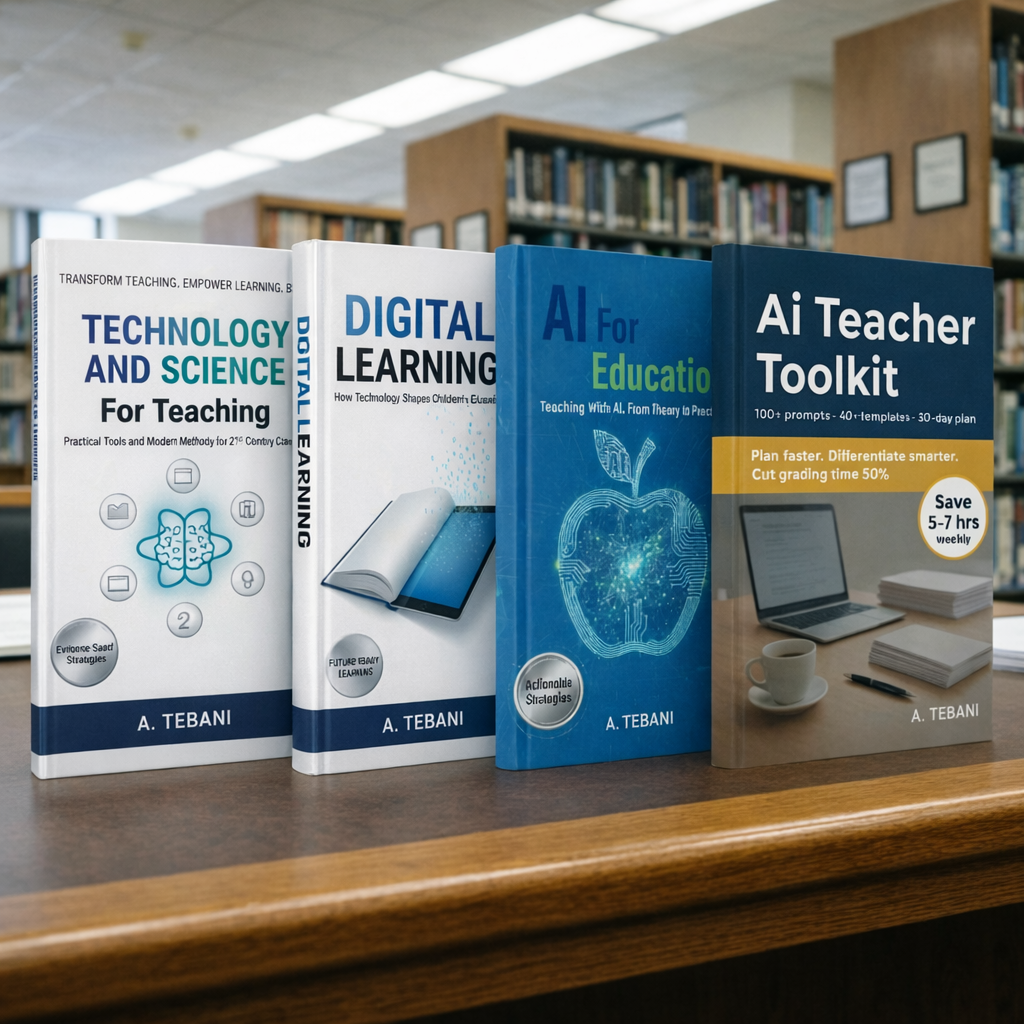
Learning and Teaching Series: Build Your Educator Toolkit in 2024
What separates educators who thrive from those who merely survive? According to a 2024 McKinsey report on education workforce trends, teachers who invest in comprehensive professional development resources report 47% higher job satisfaction and demonstrate measurably better student outcomes. Yet most educators piece together their professional growth from scattered workshops, random Pinterest boards, and whatever free resources they stumble upon online.
The Learning and Teaching Series represents a different approach: a curated, interconnected collection of resources designed to work together as a unified system. This article explores how bundled educational resources can transform your teaching practice, why the traditional approach to professional development falls short, and how to build a sustainable educator toolkit that grows with your career.
By the end of this guide, you will understand the three core pillars of effective educator resource bundles, discover a practical framework for integrating new teaching strategies without burnout, and learn how to evaluate whether a resource collection truly serves your professional needs. Whether you teach kindergarten or graduate seminars, the principles here apply across contexts and content areas.
The Fragmentation Problem: Why Scattered Resources Fail Educators
Consider the typical teacher’s professional development journey. Monday brings a webinar on differentiated instruction. Wednesday offers a department meeting focused on assessment strategies. Friday delivers an email newsletter about classroom management techniques. Each resource exists in isolation, disconnected from the others, competing for limited mental bandwidth.
Research from the Learning Policy Institute reveals that fragmented professional development produces minimal lasting change. Teachers need approximately 49 hours of sustained, coherent learning on a single topic before implementing meaningful classroom shifts. Yet the average educator receives professional development in 90 minute increments spread across unrelated topics.
The Hidden Costs of Resource Scattering
Beyond the obvious time waste, fragmented resources create several hidden costs:
- Cognitive switching penalties: Each time you shift between unrelated teaching frameworks, your brain expends energy reorienting. This leaves less mental capacity for actual implementation.
- Integration burden: You become responsible for connecting disparate ideas into a coherent practice. This work should happen at the resource design level, not in your already overloaded schedule.
- Contradictory advice: Different sources often recommend conflicting approaches. Without a unified framework, you waste time reconciling incompatible strategies.
- Incomplete coverage: Random resource collection inevitably leaves gaps. You might have excellent assessment tools but no corresponding instructional strategies to address what assessments reveal.
The solution lies not in finding better individual resources but in adopting integrated resource systems designed to work together from the start.
The Learning and Teaching Series Framework: Three Pillars of Integrated Educator Resources
Effective educator resource bundles share three essential characteristics. Understanding these pillars helps you evaluate any professional development collection, whether you build your own or invest in a curated series.
Pillar One: Conceptual Coherence
Every resource within an effective bundle should share underlying educational philosophy. This does not mean rigid uniformity. Rather, it means the pieces connect through consistent principles about how learning works, what effective teaching looks like, and how educators grow professionally.
When evaluating a resource bundle, ask: Do these materials share a recognizable theory of learning? Can I trace connections between different components? Would implementing one resource naturally lead me toward another?
Practical application: Before adopting any new teaching resource, identify its core assumptions about student learning. Compare these assumptions against resources you already use. Significant philosophical conflicts signal integration problems ahead.
Pillar Two: Progressive Complexity
Quality resource bundles scaffold professional growth. Entry points exist for educators at any experience level, while advanced materials challenge veteran teachers. The progression feels natural rather than arbitrary.
Consider how a well designed Learning and Teaching Series might structure content:
- Foundation level: Core concepts, essential vocabulary, fundamental techniques applicable across contexts
- Application level: Subject specific adaptations, grade level modifications, common challenge solutions
- Mastery level: Advanced differentiation, leadership applications, mentoring frameworks for supporting colleagues
This structure allows you to enter at your current level and grow without switching systems. Your investment compounds over time rather than requiring constant replacement.
Pillar Three: Implementation Support
The gap between knowing and doing represents the greatest challenge in professional development. Effective resource bundles bridge this gap through implementation scaffolds: templates, checklists, planning guides, reflection protocols, and troubleshooting resources.
A bundle that only provides information fails the implementation test. Look for resources that answer: What do I do Monday morning? How do I know if this is working? What adjustments should I make when challenges arise?
Ready to build your complete educator toolkit? The Learning and Teaching Series bundle brings together comprehensive resources designed to work as an integrated system. Get the complete collection and start implementing immediately: Access the Learning and Teaching Series on Amazon
The Integration Protocol: Adopting New Resources Without Overwhelm
Even the best resource bundle fails if you cannot integrate it into existing practice. The following protocol, developed through work with hundreds of educators, provides a sustainable adoption pathway.
Week One: Orientation and Selection
Resist the urge to implement everything simultaneously. During your first week with any new resource collection:
- Survey all available materials without deep reading
- Identify the single component most relevant to your current teaching challenge
- Note connections between your selected component and others you might explore later
- Set a realistic timeline: one new strategy per month, not per week
Common mistake to avoid: Many educators attempt to implement three or four new strategies simultaneously, master none, and conclude the resources do not work. The resources are not the problem. The adoption pace is.
Week Two Through Four: Focused Implementation
With your single selected strategy, move through these implementation phases:
Days 1 through 3: Study phase. Read the relevant materials completely. Take notes on key concepts. Identify potential obstacles specific to your context. Prepare any necessary materials or environmental changes.
Days 4 through 10: Trial phase. Implement the strategy in low stakes situations first. A single class period, one student group, or a non assessed activity. Gather data on what happens. Resist judgment during this phase.
Days 11 through 21: Refinement phase. Based on trial data, adjust your implementation. Expand to additional contexts gradually. Document what works in your specific situation.
Days 22 through 28: Integration phase. Connect the new strategy to existing practices. Identify natural links to other bundle resources. Prepare for your next implementation cycle.
The Reflection Checkpoint
Before moving to additional resources, complete this self assessment:
- Can I implement this strategy without consulting the original materials?
- Have I used this strategy successfully in at least three different contexts?
- Can I explain this strategy to a colleague clearly enough for them to try it?
- Have I identified at least one modification that makes this strategy work better in my specific situation?
If you answer yes to all four questions, you are ready to add another resource. If not, extend your implementation period. Depth beats breadth in professional development.
Evaluating Resource Bundles: A Decision Framework for Educators
Not all bundled resources deliver equal value. Use this framework to evaluate any collection before investing time or money.
The Authorship Test
Who created these resources? Look for:
- Classroom experience: Authors should have substantial recent teaching experience, not just theoretical knowledge
- Diverse contexts: Resources created from experience in multiple settings transfer better than those developed in a single school or district
- Ongoing practice: Authors still connected to classroom realities create more practical resources than those who left teaching decades ago
The Specificity Test
Vague advice helps no one. Evaluate resources for actionable specificity:
- Do materials include specific language to use with students?
- Are time estimates provided for activities and implementations?
- Do examples include enough detail to actually replicate them?
- Are common variations and adaptations addressed explicitly?
Resources that only provide principles without procedures fail the specificity test. You need both.
The Sustainability Test
Some resources demand unsustainable effort levels. Before adopting any bundle, consider:
- What is the ongoing time requirement for implementation?
- Do strategies require materials or technology you cannot reliably access?
- Can you maintain these practices during high stress periods like report card season or standardized testing windows?
- Do the resources account for the realities of large class sizes, limited planning time, and competing demands?
The best resources acknowledge constraints rather than ignoring them.
Building Your Personal Learning and Teaching Series Library
Whether you adopt a pre built bundle or curate your own collection, certain categories deserve representation in every educator’s professional library.
Category One: Instructional Design Resources
These materials address how you plan and structure learning experiences. Essential components include:
- Lesson planning frameworks adaptable across content areas
- Unit design templates that ensure coherent learning progressions
- Differentiation strategies for diverse learner needs
- Engagement techniques backed by cognitive science research
Category Two: Assessment and Feedback Tools
Assessment drives learning when done well. Your collection should include:
- Formative assessment techniques requiring minimal preparation
- Feedback frameworks that promote student growth
- Self assessment and peer assessment protocols
- Data analysis approaches that inform instructional decisions
Category Three: Classroom Environment Resources
The learning environment shapes everything else. Include materials addressing:
- Relationship building strategies for diverse student populations
- Proactive classroom management approaches
- Physical and virtual space organization
- Community building activities and protocols
Category Four: Professional Growth Materials
Your development as an educator requires intentional attention. Seek resources covering:
- Reflective practice frameworks
- Peer collaboration structures
- Work life sustainability strategies
- Career development pathways
A comprehensive Learning and Teaching Series addresses all four categories with interconnected resources that reference and reinforce each other.
Frequently Asked Questions About Educator Resource Bundles
How do I know if a resource bundle is worth the investment compared to free materials?
Free resources often cost more in hidden ways: time spent searching, effort integrating incompatible materials, and frustration from incomplete coverage. Calculate your hourly rate and estimate how many hours you spend curating free resources monthly. Quality bundles typically pay for themselves within weeks through time savings alone. Additionally, professionally developed bundles undergo editing, testing, and refinement that most free resources lack. The question is not whether you can find free alternatives but whether those alternatives deliver equivalent results for equivalent effort.
What if my school already provides professional development resources?
School provided resources and personal professional libraries serve different purposes. District materials typically address institutional priorities and compliance requirements. Personal resources address your specific growth areas, teaching style, and career goals. The most effective educators maintain both: they engage fully with school provided development while building personal collections that support individual professional identity. Think of school resources as your professional baseline and personal resources as your competitive advantage.
How many resources should I actively implement at once?
Research on habit formation and skill acquisition suggests focusing on one new strategy until it becomes automatic before adding another. For most educators, this means implementing one significant new approach per month during the school year, with more intensive learning possible during summer breaks. Attempting to implement multiple new strategies simultaneously typically results in shallow adoption of all rather than deep integration of any. Quality implementation of fewer strategies outperforms superficial adoption of many.
Can resource bundles work for educators at different experience levels?
Well designed bundles include multiple entry points. New teachers might focus on foundational classroom management and lesson planning resources. Mid career educators might emphasize differentiation and assessment refinement. Veteran teachers might explore leadership applications and mentoring frameworks. The key is selecting your entry point based on current needs rather than attempting to work through materials sequentially. A quality Learning and Teaching Series accommodates this non linear engagement while maintaining coherence across experience levels.
Taking Action: Your Next Steps Toward an Integrated Educator Toolkit
Building an effective professional resource library requires intentional action. Here are three concrete steps you can take this week:
- Audit your current resources: Gather all professional development materials you have accumulated. Identify gaps, redundancies, and philosophical conflicts. This audit reveals what you actually need versus what you have been randomly collecting.
- Define your priority growth area: Rather than pursuing general improvement, identify the single aspect of your teaching that would benefit most from focused development. This focus guides resource selection and prevents scattered adoption.
- Commit to the integration protocol: Whatever resources you choose, implement them using the structured approach outlined above. One strategy, fully integrated, before moving to the next.
The difference between educators who continuously improve and those who plateau often comes down to resource strategy. Scattered, random professional development produces scattered, random results. Integrated, coherent resource systems produce integrated, coherent growth.
The Learning and Teaching Series bundle offers exactly this kind of integrated system: resources designed to work together, supporting educators across experience levels and teaching contexts. If you are ready to move beyond fragmented professional development toward a unified approach, this collection provides the foundation you need.
Start building your complete educator toolkit today: Get the Learning and Teaching Series on Amazon and transform how you approach professional growth.
